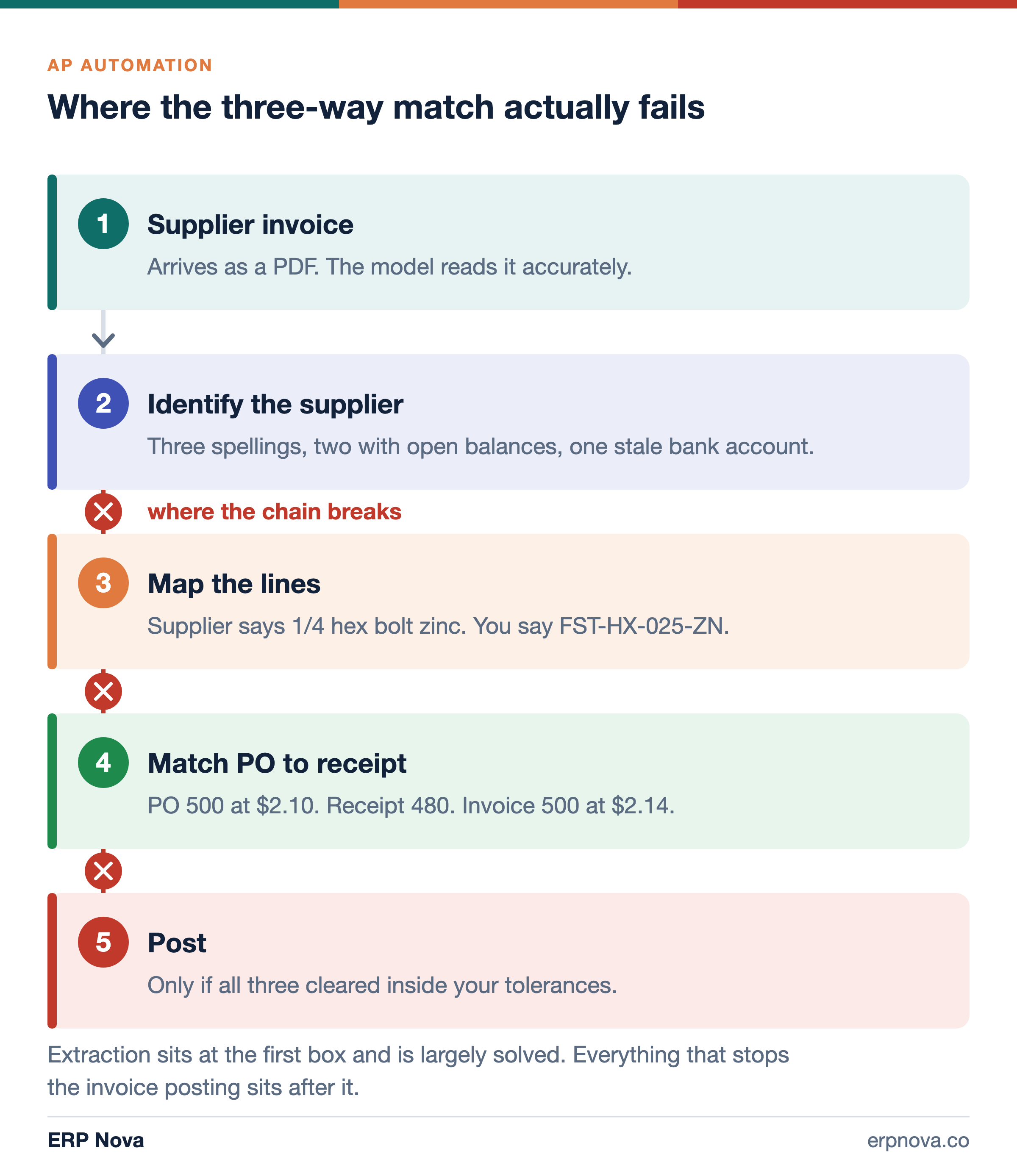
An invoice arrives from Acme Industrial Supply Co. The model reads it perfectly. Supplier, number, date, every line, the tax, the total.
Your supplier master holds Acme Industrial, ACME Industrial Supply, and Acme Ind Supply Co. Two carry open balances. One has remittance details that stopped being correct in 2023.
The extraction is flawless. The invoice still cannot post.
The short answer. OCR accuracy is not what stops invoice automation in ERPNext. Three preconditions decide it: whether the supplier on the invoice maps to one unambiguous record, whether the line items map to item codes, and whether the purchase order to receipt to invoice match closes inside tolerance. Measure your touchless rate before buying extraction.
Last updated: 20 August 2026.
What currently ranks
Search for AI invoice processing in ERPNext (checked 19 August 2026): a marketplace app, two LinkedIn posts, two GitHub repositories with one star between them, and a 2021 Frappe forum thread.
We opened the paid invoice-OCR listing on the Frappe Cloud marketplace and that thread. Neither mentions three-way matching, item code mapping, or supplier master hygiene, and the listing publishes no accuracy rate and nothing about purchase order matching.
Extraction stopped being the constraint
In the invoices we have put through current models, extraction is rarely what fails. We have not benchmarked that, which is the point of the test below. It is further along than Frappe itself ships.
So if a human still opens the draft to decide which supplier it is, you have automated typing. That was not the expensive part.
Can you identify the supplier?
Masters like that get built over years by several people, which is how they end up holding three spellings of one company, with remittance details that diverge when a bank account changes.
The model has the name right. A guess produces a payable nobody will pay, or a payment to a stale account.
The fix is not a better model. Deduplicate the master and hold one identifier per supplier that appears on their paperwork, usually the tax ID.
Do the lines map to item codes?
The invoice reads "1/4 hex bolt zinc plated, box of 100". Your item master says FST-HX-025-ZN. Nothing in the PDF connects them: suppliers use their own part numbers.
Until that mapping is stored per supplier, every line is a human decision. Populate it for your top 30 by volume.
Does the match close?
A PO says 500 at $2.10. The receipt says 480. The invoice says 500 at $2.14.
A genuine exception, and no model should decide it. A system that posts it quietly creates a wrong entry with an audit trail saying a computer approved it.
ERPNext handles the machinery, and the tolerances are real settings, though neither sits in Buying Settings where most people look.
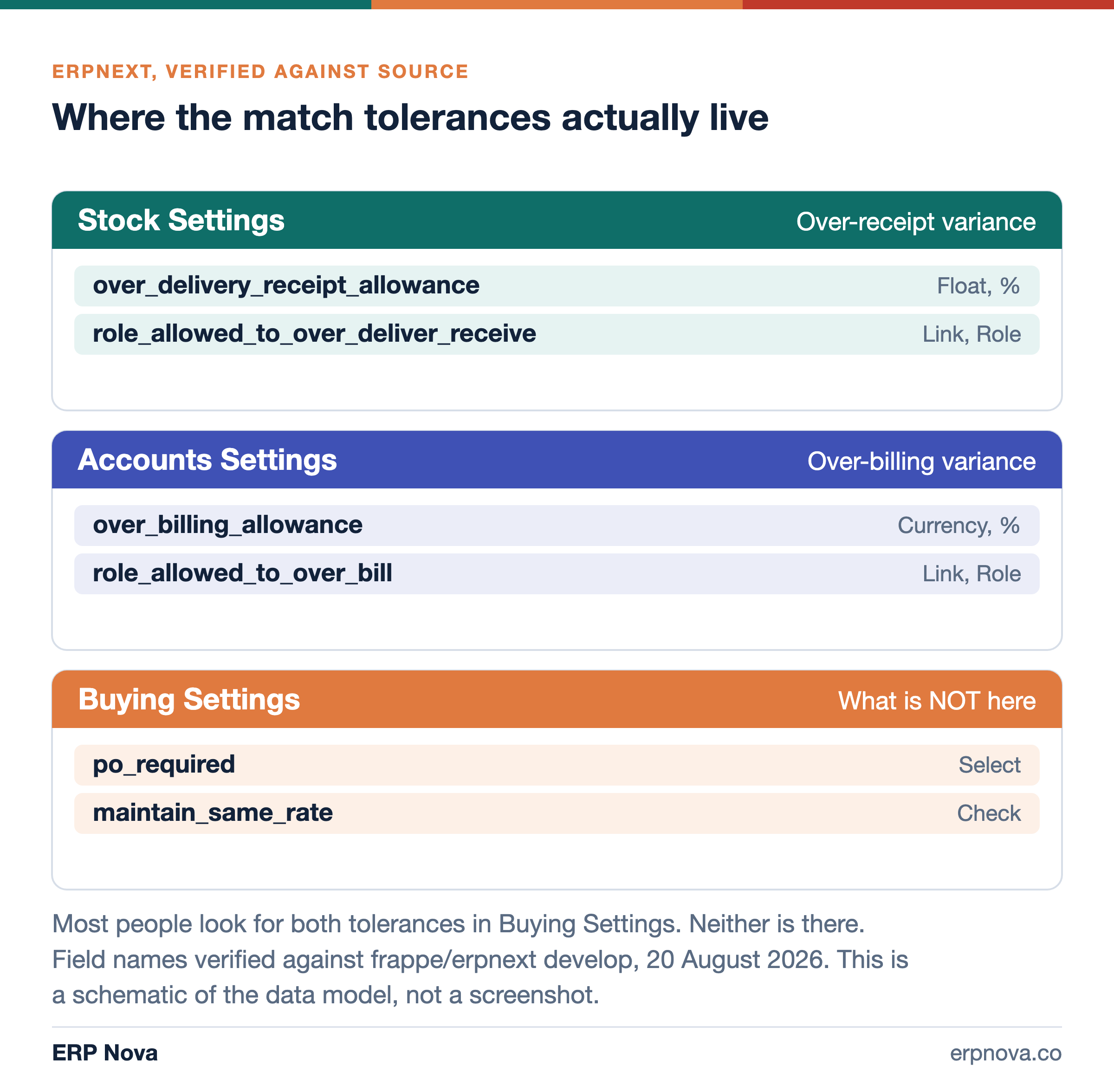
Those two numbers are a policy decision and the highest leverage setting here. Too tight and everything is an exception. Too loose and you have automated the acceptance of overbilling.
Measure your touchless rate first
| Check | How to run it | If no |
|---|---|---|
| Did it arrive against a PO? | Count invoices with a matching order. | A procurement policy problem. |
| Goods receipt, quantity matched? | Compare received to invoiced, line by line. | A receiving discipline problem. |
| Did the price match? | Invoice unit price against the PO. | A pricing agreement nobody recorded. |
| Supplier unambiguous? | Search the master for near-duplicates. | A week of deduplication. |
| Lines map to item codes? | Code ten invoices from the PDF alone. | Store mappings for your top 30. |
All five yes, divided by the total, is your ceiling.
Fix in this order
- Supplier master. One record per legal entity, with an identifier that appears on their paperwork
- No-PO purchasing. A policy problem, and the cheapest fix here
- Item mapping for your top 30 suppliers
- Tolerances. Decide what may post without review
- Then add extraction, which now works because everything it hands over has somewhere to go
Reversing that order produces wrong entries faster. Wrong entries in AP are found by suppliers, not by you.
What ERPNext already does here
More than most people expect. The buying flow runs end to end, the goods-received-not-billed accrual is correct out of the box rather than a monthly hand journal, and both tolerances are real settings, so the variance policy is yours.
The exception queue and approval hierarchy that a standalone AP product sells separately is a screen we build on top, once, against how your team actually works. Because the platform is scriptable, that routing matches your process instead of a vendor's, and there is no per-seat rent on it.
Supplier master hygiene, worth saying, is not a feature in any ERP. That one is data work whoever you buy from, which is why it is first on the list above.
Try the test before the software
Last month's invoices, five questions, an afternoon. Run it before you take a demo.
Or send us last month's invoice register and we will run the five questions and show you your ceiling and what sits under it. Above 70 percent, our advice is to go and buy extraction rather than talk to us further, because at that point a tool really is what you need. erpnova.co
Frequently asked questions
Does ERPNext have AI invoice processing?
Not natively. A paid marketplace app and two small open source repositories supply it. The listing publishes no accuracy rate and says nothing about purchase order matching, supplier hygiene, or item mapping, which are the three things that decide whether automation works.
What is a three-way match in ERPNext?
Matching the purchase order, the goods receipt and the supplier invoice before anything posts. ERPNext carries this natively, and goods received but not billed accrue to their own account. The variance tolerances are Over Delivery/Receipt Allowance in Stock Settings and Over Billing Allowance in Accounts Settings.
Where are the purchase tolerances set in ERPNext?
In two places, which is why people miss them. Over-receipt is Over Delivery/Receipt Allowance in Stock Settings. Over-billing is Over Billing Allowance in Accounts Settings. Each has a companion field naming the role permitted to breach it, so a supervisor can pass an exception without opening the tolerance for everyone.
What is a realistic touchless invoice rate?
Run the five question test and you get your own number rather than a benchmark. Our working thresholds are above 70 percent to buy extraction, below 50 percent to fix master data first. The gap is rarely extraction: it is usually purchasing without a purchase order, and item mapping, a data project rather than a licence.
About ERP Nova
ERP Nova is the ERPNext implementation practice of Vish Gyana Technology Solutions, an official Frappe Partner. We work with mid-market manufacturers in CPG and food, pharma, and electronics. erpnova.co
Comments
Join the discussionNo comments yet. Be the first to comment.