Accurate as of 19 August 2026. Everything below moves. Check the dates before you act on any of it.
Roughly 330,000 importers paid or deposited an estimated $166 billion in IEEPA duties across more than 53 million entries. As of 4 August 2026, about $128.68 billion had entered CBP's refund process and roughly $100 billion had been certified and sent to Treasury including interest, which is around 60 percent of the pool.
Now search for how an ERP should handle tariffs and landed cost. We did. The top eight results are all vendor pages explaining landed cost as a product feature, and none of them mentions any of the above.
That gap matters, because the refund is a data problem before it is a cheque and an inventory valuation problem after it, and both of those live in your ERP rather than at your broker.
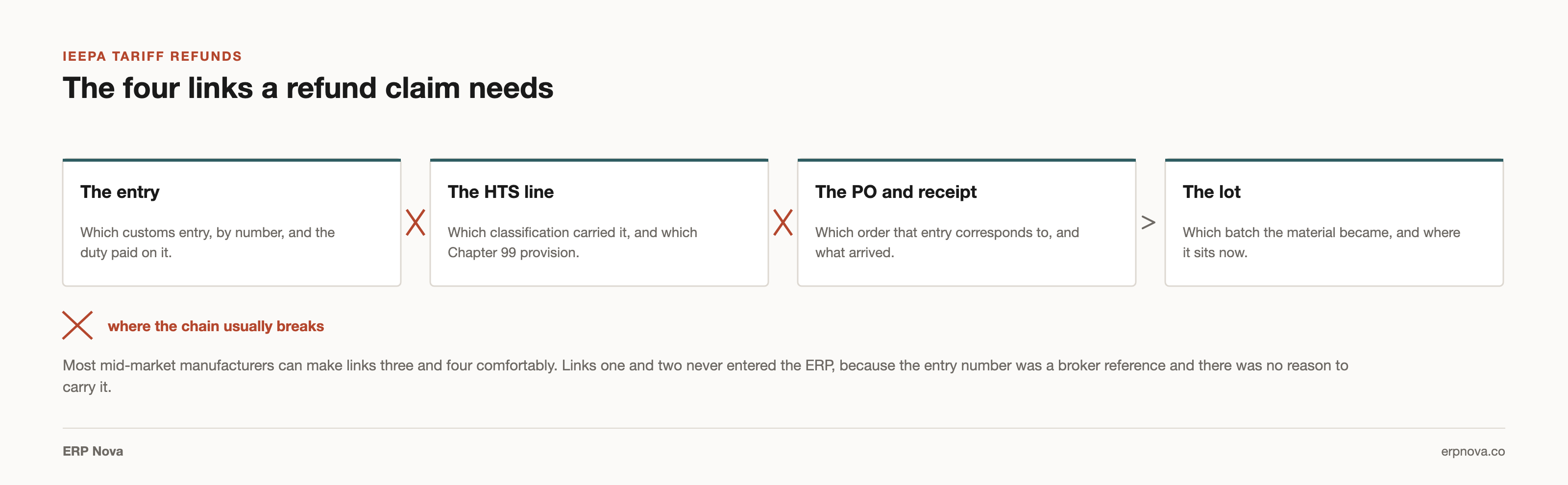
The short answer. An IEEPA tariff refund needs four links most ERPs cannot make: the customs entry, the HTS line that carried the duty, the purchase order and receipt, and the lot the material became. The duty was capitalised into inventory, so the refund is also a cost of goods sold and inventory valuation problem, not just a cheque.
Last updated: 19 August 2026.
Where things stand
Dated, and attributed, because the half-life here is short.
20 February 2026. The Supreme Court held that IEEPA does not authorise the president to impose tariffs, affirming the Federal Circuit's ruling of 29 August 2025. The Court's reasoning was that the power to impose tariffs is "very clear[ly] ... a branch of the taxing power" and belongs to Congress. The Court of International Trade had first found the tariffs unlawful on 28 May 2025.
4 March 2026. Judge Richard K. Eaton at the CIT ordered CBP to liquidate or reliquidate all entries that are "not final" without regard to IEEPA duties, and held that the court retains jurisdiction to order refunds to all importers rather than only the parties before it.
20 April 2026. CBP opened CAPE, the Consolidated Administration and Processing of Entries, inside the ACE portal. 29 June 2026, Phase 2 opened, covering entries flagged for Reconciliation where no Reconciliation entry was filed.
17 July 2026. Judge Eaton ordered CBP to "reliquidate, without regard to IEEPA duties, any and all of Plaintiffs' entries that have been liquidated for more than 80 days."
4 August 2026. CBP's progress report on Phase 3 was due.
Once accepted, a CAPE declaration typically produces a refund in 60 to 90 days absent a compliance concern.
One important caveat about all of the above. We could not reach cbp.gov. The CAPE page returned a 403 to our fetcher, both during research for this piece and a week earlier. Every procedural detail here therefore comes from law firm alerts and customs brokerage summaries rather than from CBP directly. They are consistent with each other, which is reassuring but is not the same as primary. Your broker has the actual guidance and you should use it.
Who is on the wrong side of the cliff
Read the 17 July order carefully, because the phrasing does a lot of work.
It orders reliquidation of Plaintiffs' entries. It applies to companies that had filed cases seeking IEEPA refunds at the CIT. An importer who never filed a protest or a claim is not reached by it.
That is the difference between the two groups nobody explains clearly. For entries that were not yet final, the March order is broad and CBP has been processing at scale. For entries that were finally liquidated, whether you are in the queue at all depends on whether you took an action, at a time when taking that action looked optional.
If you are in the second group and did nothing, this is a conversation to have with a trade attorney this week rather than next quarter. We are not the right people to advise on it and we will say so again below.
Why this is a data problem
Whatever your eligibility, a claim needs you to prove what you paid. That means four links, in a chain.
The entry. Which customs entry, by number, and what duty was paid on it.
The HTS line. Which tariff classification carried the duty, and specifically which Chapter 99 provision, because that is how IEEPA duties are identified. Practitioners point importers at the Entry Summary Detail Report, ES-003, exported to Excel and filtered on the HTSUS column and Chapter 99 provisions, precisely because this link is the one people cannot make from their own records.
The purchase order and receipt. Which order that entry corresponds to, and what was actually received against it.
The lot. Which received lot or batch the material became, and where that material is now.
Most mid-market manufacturers can make link three and link four comfortably. Their ERP knows what they bought and what they received and where it went.
They cannot make links one and two, because that data never entered the ERP.
Where the data actually lives
At the broker.
Your customs broker filed the entry, holds the entry summary, and knows the classification. What arrived in your ERP was a supplier invoice, a freight bill, and possibly a duty line coded to an expense account or bundled into a landed cost voucher without the entry number anywhere on it.
This is not negligence. Nobody designed for a $166 billion reversal. The entry number was a broker's reference and there was no reason to carry it.
The consequence is that reconciling a refund claim back to your own inventory becomes a spreadsheet exercise across two systems that share no key. Companies doing this now are matching on dates, supplier names, and amounts, which is exactly as reliable as it sounds.
What a refund does to your inventory valuation
Here is the part nobody writes, and it is squarely a controller's problem rather than a customs one.
Duty is a cost of acquiring inventory. It was capitalised into the landed cost of the material. That material became a batch, that batch became finished goods, and some of those finished goods left on a truck.
So when the refund arrives, there are three cases and they are treated differently.
Inventory already sold. The duty flowed through cost of goods sold when you sold it. The refund is a credit in the period you receive it. Your gross margin on those historic sales was overstated at the time, and it is now understated in the period of receipt. If the amounts are material relative to your P&L, your auditor will want to see the analysis, and if you report to a lender on margin covenants, so will they.
Inventory still on hand. This is the one that quietly persists. Material sitting in your store is carrying duty in its cost basis, and that duty is being refunded. Until somebody revalues it, every unit that ships out of that stock carries an inflated cost into margin. If you run standard costing, the standard was set with duty in it, and your purchase price variance is now telling you a story about a tariff that no longer exists.
Inventory in work in progress. The same problem with an extra step, because the cost is now inside a partially completed job and revaluing it means deciding whether to touch open work orders or let them finish at the old basis and correct on completion. Usually the latter is right and the point is to make it a decision rather than an accident.
None of the three is difficult. All three require you to know how much duty is in the cost of what specific material, which brings you straight back to the four links.
| Where the duty sits | What happened to it | Treatment and ERP action |
|---|---|---|
| Inventory already sold | The duty flowed through cost of goods sold when you sold it. | A COGS credit in the period you receive it. Historic gross margin was overstated. If material, your auditor will want the analysis. |
| Inventory still on hand | Sitting in the cost basis of stock in your store, unrefunded on your books. | Revalue. Until you do, every unit shipping from that stock carries an inflated cost into margin, and PPV reports a tariff that no longer exists. |
| Inventory in work in progress | Inside a partially completed job. | Usually let open work orders finish at the old basis and correct on completion. The point is deciding, rather than discovering it later. |
This is ordinary cost accounting reasoning, not published guidance, and we could find none addressing it. Your auditor's view governs. Have the conversation before the refund arrives.
Say this plainly to your accountant before you do anything. The treatment above is ordinary cost accounting reasoning, not published guidance, and we could find no guidance addressing it. Your auditor's view governs, and it is a short conversation worth having before the refund arrives rather than after.
What to build now, refund or not
Even if you recover nothing, these are worth doing, because there will be another trade event and the next one will find you in the same position.
Carry the entry number into the ERP. On the landed cost voucher, on the purchase receipt, wherever your system allows a reference. One field, populated at receipt, and the chain from entry to lot exists permanently.
Record duty as its own cost component. Not bundled into a single landed cost figure with freight and insurance. Duty separately, so it can be identified, reported, and reversed without unpicking anything.
Hold the HTS classification on the item. Your broker classifies your parts. That classification belongs on your item master too, because it makes the ES-003 reconciliation a lookup rather than an investigation.
Reconcile duty to the broker monthly. A short monthly comparison between what your ERP thinks you paid in duty and what your broker's records say. Right now most manufacturers discover the gap only when they need the data urgently.
In ERPNext specifically, the machinery exists: Landed Cost Voucher distributes additional costs across received items, and custom fields can carry the entry number and HTS classification. It is configuration and discipline, not development. The reason it is usually absent is that nobody asked for it at implementation, which was a reasonable choice in 2019 and is not one now.
What we can and cannot help with
We implement ERPNext for manufacturers. We are not customs brokers and we are not trade attorneys, and this subject is customs and trade compliance sitting adjacent to ERP rather than something an ERP partner should be advising on.
So: use your broker for the CAPE filing, and a trade attorney if you are anywhere near the finally-liquidated question. Note also that only the Importer of Record, or the broker who filed the entries, may submit claims, so the mechanics are not yours to run in any case.
What we can help with is the half nobody else is looking at, which is whether your own records can support what your broker files, and what happens in your books when the money arrives.
Pick one receipt
One import receipt from 2025. That is the whole exercise.
From your ERP alone, and without calling your broker:
which customs entry did it arrive on?
what duty was paid?
under which HTS line? and
where is that material now?
Answer all four and you are in better shape than most. The claim becomes a reporting job.
Stall on the first one, which is what usually happens, and you have found the thing worth fixing. It is configuration rather than a project. The refund window is what makes it urgent this quarter. The next trade event, whenever it lands, is what makes it worth keeping afterwards.
Try the one receipt first. If you stall on the first question, send us that receipt and your broker's entry summary and we will show you exactly where your chain breaks and what it takes to close it. Your broker files the claim and a trade attorney handles eligibility. Our half is whether your own records can substantiate either of them. Talk to us at erpnova.co
Frequently asked questions
How do you claim an IEEPA tariff refund?
Through CBP's CAPE process in the ACE portal, which opened on 20 April 2026, with Phase 2 following on 29 June 2026 for reconciliation-flagged entries. Practitioners identify eligible duties using the Entry Summary Detail Report, exported to Excel and filtered on the HTSUS column and Chapter 99 provisions. Your customs broker files it, not you.
Who can file a CAPE refund claim?
Only the Importer of Record, or the customs broker who filed the entries. The mechanics are not yours to run, which is why this is a customs and trade compliance exercise rather than an ERP one. Your side of it is whether your own records can substantiate what the broker files.
Are finally liquidated entries eligible for a refund?
Only in limited circumstances. On 17 July 2026 the Court of International Trade ordered CBP to reliquidate entries liquidated more than 80 days earlier, but that order covers plaintiffs, meaning companies that had already filed cases at the CIT. An importer who never filed a protest or claim is not reached by it. Speak to a trade attorney.
What happens to inventory value when a tariff is refunded?
Duty was capitalised into inventory cost, so there are three cases. Inventory already sold means a cost of goods sold credit in the period of receipt, with historic margin overstated. Inventory still on hand is carrying duty that is being refunded and needs revaluing. Work in progress usually finishes at the old basis and is corrected on completion.
How long does a CAPE refund take?
Refunds are typically issued 60 to 90 days after a CAPE declaration is accepted, unless a compliance concern triggers further review. Entries with antidumping duties, open protests, active drawback claims, missing HTSUS lines, or incomplete electronic records attract heightened review and take longer.
What should an ERP record so this is easier next time?
Four things. Carry the customs entry number into the ERP on the landed cost voucher or purchase receipt. Record duty as its own cost component rather than bundled with freight. Hold the HTS classification on the item master. Reconcile duty to your broker's records monthly.
Sources
US Supreme Court decision on IEEPA tariffs, 20 February 2026, CRS summary
CIT orders CBP to process refunds for Phase 3 finally liquidated entries, 17 July 2026
About ERP Nova
ERP Nova is the ERPNext implementation practice of VGTS, an official Frappe Partner. We work with manufacturers in CPG and food, pharma, and electronics. erpnova.co
Comments
Join the discussionNo comments yet. Be the first to comment.